Description
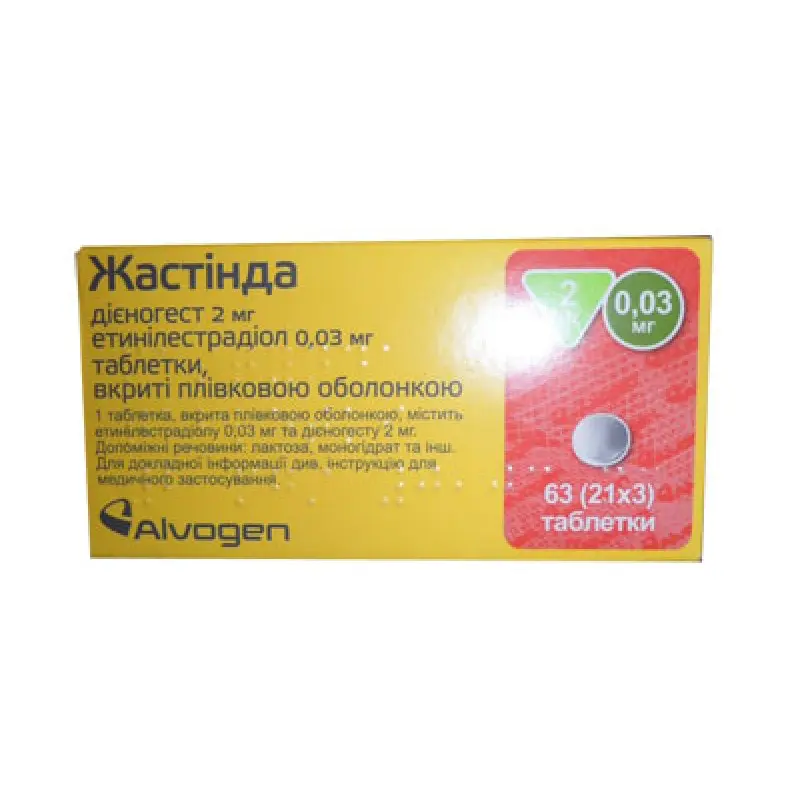
Jastinda Tablets 2 mg/0.03 mg #63
Jastinda is an oral contraceptive containing ethinylestradiol and dienogest. Each tablet is coated with a film and contains 0.03 mg of ethinylestradiol and 2 mg of dienogest. It is used for hormonal contraception under the supervision of a healthcare provider.
Composition
Each Jastinda tablet contains:
- Ethinylestradiol: 0.03 mg
- Dienogest: 2 mg
- Other ingredients: lactose monohydrate, corn starch, povidone, magnesium stearate, talc
- Tablet coating: Opaglos 2 purified, containing carboxymethylcellulose sodium, maltodextrin, dextrose monohydrate, soy lecithin, sodium dihydrate
Dosage Form
Film-coated tablets.
Physical and Chemical Properties
Jastinda tablets are white or nearly white, round, biconvex, film-coated, and free from visible contaminants.
Pharmacotherapeutic Group
Systemic hormonal contraceptives. ATC code: G03AA16.
Pharmacological Properties
Pharmacodynamics
Jastinda is a combined oral contraceptive (COC) containing ethinylestradiol and dienogest. The contraceptive effect is based on several mechanisms, the most important of which are the suppression of ovulation and alteration of cervical mucus.
Dienogest, a derivative of nortestosterone, has lower affinity for progesterone receptors compared to other synthetic progestins, but shows strong progestogenic and antiandrogenic activity. Dienogest suppresses ovulation at a daily dose of 1 mg.
Pharmacokinetics
Ethinylestradiol
Absorption: Ethinylestradiol is quickly and completely absorbed after oral administration, reaching peak serum concentrations of 67 pg/mL within 1.5–4 hours. Its bioavailability is approximately 44% due to extensive first-pass metabolism.
Distribution: Ethinylestradiol binds strongly, but nonspecifically, to albumin (98%) and induces increased serum levels of sex hormone-binding globulin (SHBG). Its distribution volume is approximately 2.8–8.6 L/kg.
Metabolism: Ethinylestradiol undergoes presystemic conjugation in the intestinal mucosa and liver. It is mainly metabolized by aromatic hydroxylation, forming various hydroxylated and methylated metabolites, some of which are conjugated with glucuronic acid or sulfate. Clearance is around 2.3–7 mL/min/kg.
Elimination: The decline in serum ethinylestradiol levels occurs in two phases, with half-lives of approximately 1 hour and 10–20 hours, respectively. Ethinylestradiol is not excreted unchanged but is eliminated as metabolites in urine and bile at a ratio of 4:6. The half-life of metabolites is about 1 day.
Steady State: Steady-state concentrations are reached in the second half of the treatment cycle, with serum levels approximately twice as high as after a single dose.
Dienogest
Absorption: Dienogest is quickly and completely absorbed after oral administration, with a peak serum concentration of 51 ng/mL achieved 2.5 hours after taking Jastinda. Dienogest has a bioavailability of approximately 96% when combined with ethinylestradiol.
Distribution: Dienogest binds to albumin and does not bind to SHBG. About 90% of the total serum concentration is bound to albumin, with only 10% circulating as free steroid. Ethinylestradiol-induced SHBG levels do not affect dienogest’s plasma binding. Its distribution volume is 37–45 L.
Metabolism: Dienogest is metabolized primarily by hydroxylation and conjugation, producing mostly inactive metabolites. These metabolites are rapidly cleared, with no active forms present in plasma. Total clearance is approximately 3.6 L/h.
Elimination: Dienogest has a half-life of approximately 9 hours. Only a small amount of dienogest is excreted unchanged via the kidneys. Around 86% of the dose is eliminated within 6 days, with 42% excreted in the urine within the first 24 hours.
Steady State: Steady-state levels of dienogest are reached after 4 days of daily use, with serum levels increasing by a factor of 1.5.
Indications
Jastinda is indicated for oral contraception.